Subscribe to my YouTube channel right here!
Fallujah has had a pretty interesting past six years. It all started with their record Undying Light in 2019, which was a release that saw the band veer away from their signature technical flair and intricate songwriting in favor of a more stripped-down, djent-tinged death metal approach. It was a misstep, and fans pretty much immediately recognized it as such. I really don’t think it’s controversial for me to say that Undying Light is, by a wide margin, the weakest and most uninteresting entry in Fallujah‘s discography. But then came the rebound.
Fallujah dropped a new record called Empyrean in 2022, which marked a serious course correction for the band and the start of a new era. Empyrean introduced vocalist Kyle Schaefer and bass virtuoso Evan Brewer, and the chemistry between both the new and old members was pretty obvious. Empyrean sounded like a band that had rediscovered what made them special, but also found a new way forward with new sounds and a new lease on life in terms of their musical longevity. Empyrean brought back the complexity and melody that made Fallujah stand out while still pushing the band’s sound forward.
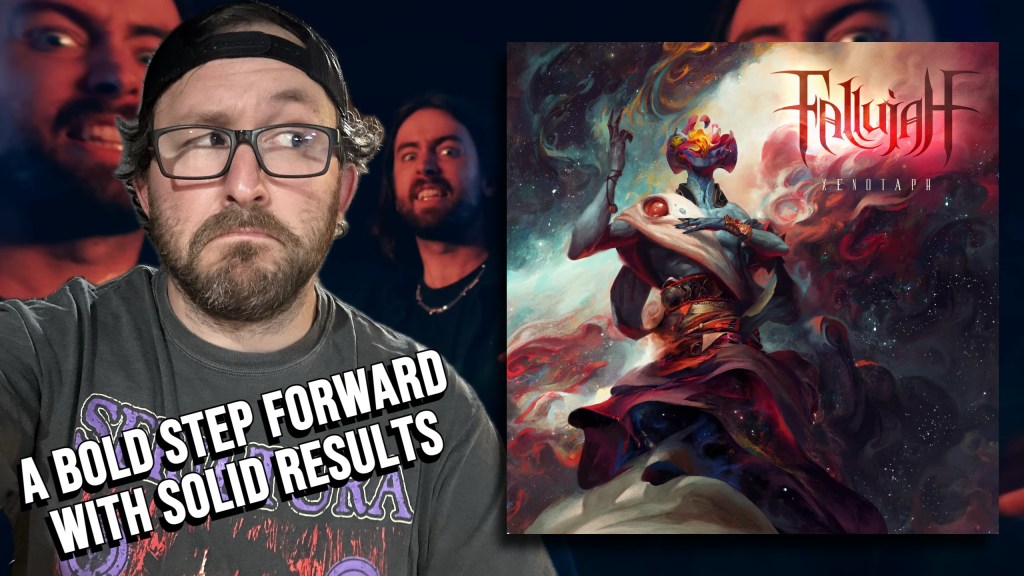
It wasn’t a nostalgia trip or a rehash to win fans back; it was a refined and modernized expression of everything that Fallujah does really well, and presented in a very smart and well-written way. Now in 2025, Fallujah is opening the next chapter of their career with Xenotaph, a record that retains the technical precision, rich melodies, and elite musicianship of Empyrean, but leans harder into more progressive territory and clean vocals than ever before.
In the press material around Xenotaph, Schaefer described the album as “our most ambitious record yet,” and it is certainly the band’s most technical, dynamic, and progressive material to date. The music carried out by these eight tracks is matched with an equally ambitious concept, a lyrical story that traverses unfolding layers of time and reality in an otherworldly, post-death realm of existence. He continued, saying that “Xenotaph is also our most collaborative album, with broad input from the current lineup leading us to expand the scope of our songwriting while simultaneously highlighting the true potential of everyone involved. We hope you’ll join us in welcoming this bold new stage of the band’s evolution.”
“In Stars We Drown” opens Xenotaph with a massive stargazing atmosphere loaded with gorgeous guitar melodies layered in clean and distorted lines, reverbed-out pianos, and clean vocals harmonized mostly in octaves with just a touch of dissonance and tight-knit lines here and there for a really nice flavor. Then, without warning, it explodes into a heavier, more technical variation of the intro which ramps up in intensity without losing any of the emotion. It’s a stunning opener to an album that sets both the musical and emotional tone.
“Kaleidoscopic Waves” picks up right where “In Stars We Drown” leaves off, leaning further into clean vocals and strong, melodic hooks. And it’s a smart move, too. The opener is short and impactful, and this track gives the listener more time to settle into this newer, more expansive, more proggy side of Fallujah. I know we’re only two tracks in, but it should be obvious at this point that Xenotaph marks a shift in Fallujah‘s sound. Where Empyrean felt tighter and more traditionally quote-unquote metal, Xenotaph feels a lot more wide-open and cosmic in its scale.
It’s as if Fallujah realized they don’t have to constantly crush the listener to leave them breathless and wanting more. They can awe them instead using a lot more space and texture and melody in the vocals. Not that they haven’t done that before—if you’ve heard any other Fallujah record, it’s very obvious that they’ve done that plenty of times and to great effect over their career. But Xenotaph feels like a fully realized version of that sound rooted in a much more proggier sound.
And that’s not to say that Fallujah has lost their edge, because they definitely haven’t. “Labyrinth of Stone” brings back that heaviness with a gritty, aggressive opening and verse, and it’s definitely a reminder that Fallujah can still be plenty deadly when they want to be. But then there’s the clean chorus in the song, which I should note that I’ve had stuck in my head for quite a few weeks now. And it shows just how confidently Fallujah is in integrating melody into their arsenal of sounds.
Even more impressive is the ambient second chorus that floats in at about a minute and a half after the first one, which adds some depth without disrupting the song’s power. “Labyrinth of Stone” doesn’t feel like a blend of old and new—it feels like a natural result of a band that’s kind of mastered both what they’ve been doing and what they want to do.
“The Crystalline Veil” closes out the first half of the album by dialing back the mania slightly. The chorus line, “oh dreamer, fly with me, or fall deeper down in sleep,” is yet another earworm that again has been stuck in my head for quite some time now. Though the real star of this track is drummer Kevin Palermo. His dynamic performance really anchors the song and shifts seamlessly from hard-hitting death metal power to more nuanced, groove-heavy parts that really elevate the atmosphere.
So we’re about halfway through Xenotaph in this review and I just want to say that I do really like the first half. My only problem is that a lot of the heavier parts kind of blend together and just sort of do the same stuff that Fallujah normally does on all their other records, which is not necessarily a bad thing. But considering how good the earworm parts and the clean vocal parts and some of the melody parts are—and the atmospheres—and also just how experimental and good the second half of this record is, it does feel like the first half could have been bumped up just a little bit.
The second half begins with “Step Through the Portal and Breathe,” which slows things down quite a bit. There’s prominent bass work that takes the spotlight at parts, clean gang vocals with some hidden screams stretched across the mix, and a tempo that drops and shifts for a breathier, more ambient transition when it’s needed.
Then there’s “A Parasitic Dream,” which is a track that feels like a shoegaze band got filtered through a tech-death lens. It’s dreamy and atmospheric, but it’s definitely still pretty heavy. Melodies soar over the blast beats and there’s kind of a beauty buried inside the distortion on this one. At this point, Xenotaph clearly takes on a more experimental tone from here to the end of the record. Rather than repeating the first half or settling into a formula, the second half really expands the palette and really blows this record up into what I think it should be the whole time.
Despite “Step Through the Portal and Breathe” and “A Parasitic Dream” being very good songs, Fallujah has somehow saved the two strongest tracks on Xenotaph for last. “The Obsidian Architect” is filled with new textures from distant synths and fluttering vocals and a harmonic structure that really signals a deep shift in the mood of this record. It sounds like something is unraveling, something bad is happening, or at least the contemplation of the main character and everything that surrounds them is starting to turn sour.
And then finally there’s the title track. “Xenotaph” enters with blistering speed, tearing through time changes, ambient interludes, and crushing death metal passages. It carries forward the darkness introduced by “The Obsidian Architect” and ends in pure catharsis. There’s driving riffs, there’s soaring clean vocals, and a final fade into the stars. It feels like this really cosmic sendoff that just feels so earned and massive and strangely peaceful in a way.
I guess it boils down to me having two main gripes about this record. One is that the heavier parts, especially in the first half, can blur together a bit. At times they feel more like vehicles to get to the hooks than standout moments on their own. But even then, these sections are still solid, they’re still enjoyable, and they’re often just a hair away from being pretty damn good. But compared to the hooks—and again, the second half—it just feels like Fallujah needed to step up their game a little bit more in the first half.
My other gripe about Xenotaph is the lack of dynamic range in the mix and master. For a record that seems to want to thrive on contrast by switching between these ambient sections and big clean vocals and big heavy parts, it feels like everything sits at a fairly uniform volume. And that consistency dulls some of the impact of what Fallujah is trying to do. A more dynamic mix could’ve really elevated the tension and release Fallujah is clearly aiming for with their writing.
As it stands, the songs are strong enough to carry it without that being the case, but more breathing room in the production would’ve really pushed the whole experience even further. All told, Xenotaph is a solid seven out of ten for me. It’s a confident step in a new chapter for Fallujah, and I’m genuinely excited to see how this sound continues to evolve for them.
For a band that’s been active for nearly two decades through numerous lineup changes, all guided by guitarist Scott Carstairs, it’s impressive how they’ve managed to reinvent themselves without losing the elements that fans connect with and that make Fallujah Fallujah. This isn’t just a good record, it’s a testament to a band still pushing forward, still experimenting, and still very much worth paying attention to. I just want to see them push this a little bit further because in my heart, I genuinely believe this band is capable of doing something really, truly great.
 (The) Greg Kennelty