Subscribe to my YouTube channel right here!
Alright, so in my last video I talked about all my favorite rock and metal albums that have come out in 2025 so far. And for this video, I wanted to do something different and talk about albums that really disappointed me.
I want to make it clear right up top that these are not records that I’ve chosen specifically to dunk on because they’re popular or whatever the case is – these are artists that I really do like, and I just felt like they released some pretty iffy albums this year. And much like the other video, I’m going to talk about these in alphabetical order as well, just so it doesn’t seem like there’s one that I really, really disliked and then I’m kind of ranking them. This is all gonna be in alphabetical order, and there are five of them. So here we go.
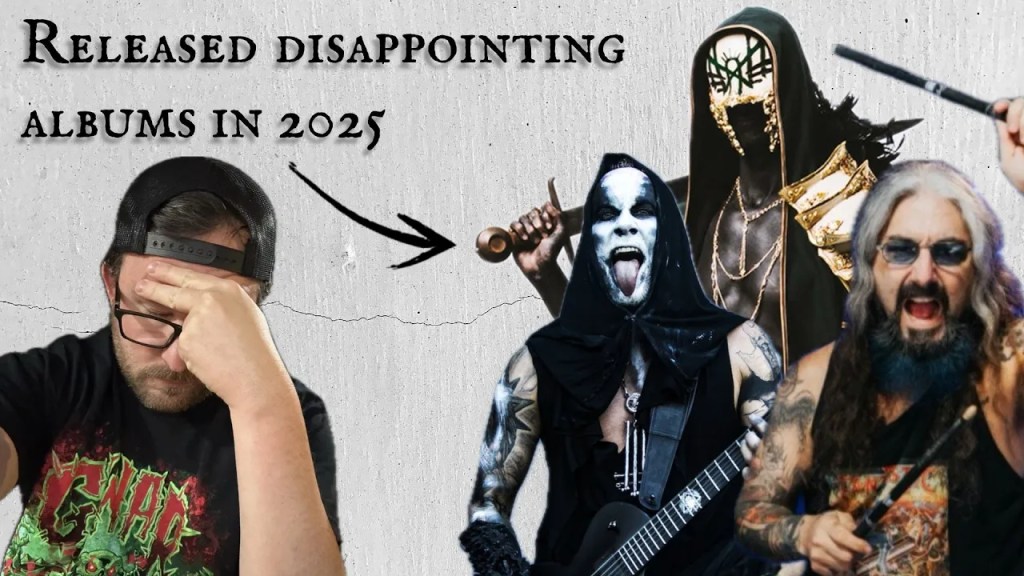
The Shit Ov God by Behemoth
Behemoth’s new record The Shit Ov God is proof that they’ve creatively flatlined, or at least they’ve traded trying to push themselves forward as artists for shock value and boring merchandising opportunities. The Shit Ov God isn’t dangerous or provocative or even interesting, it’s just loud and tired and desperate to offend people who stopped being offended by upsidedown crosses years ago. Which, again like I’ve said before, truly sucks because Behemoth has put out a lot of good to great records throughout their career. The run of Demigod, The Apostasy, Evangelion, and The Satanist alone was enough to cement Behemoth as one of the greats. But they’ve been chipping away at that foundation of being great ever since then.
2018’s I Loved You at Your Darkest and 2022’s Opvs Contra Natvram are both limp attempts at maintaining the band’s reputation without any real fire or creativity behind them. It’s a lot of cringe lyrics, safe songwriting, and an overall reliance on edgelord aesthetics that made both records feel super hollow – and The Shit Ov God is just kind of the pinnacle of that badness.
I think one of the other really frustrating parts about this record is that Behemoth is still made up of very good, top-tier musicians. The performances on this record are tight, the production is fine, and the sound is very recognizably Behemoth. But that’s kind of the problem. It’s just modern Behemoth. It’s just Behemoth doing what they’ve been doing for the past few years and there’s really no movement, no evolution, no edge. It’s just more of the same and it’s all presented with this grimace and a middle finger, as if that’s kind of enough to make us feel something. But it’s not. We want the artistry from Behemoth, because Behemoth can do that. They’re just choosing not to.
I really want to like modern Behemoth. I spent years loving their music and I still think The Satanist is one of the best extreme metal albums of the 2010s. But at this point, Behemoth has become a shadow of a shadow of their former selves and it doesn’t seem to be getting better anytime soon.
Parasomnia by Dream Theater
The hype around Dream Theater‘s Parasomnia was very real, and for good reason. This was the band’s first album with founding drummer and longtime creative force Mike Portnoy back in the band since Black Clouds & Silver Linings in 2009. But Parasomnia isn’t really a triumphant return with Mike Portnoy behind the kit and being a creative driving force in the band. Instead, it sounds like Dream Theater trying to find their footing again after a long separation. It’s more of a reconvening than it is a reviving of the band.
And that’s not to say that Parasomnia is without merit, because it’s not an awful record. There’s an undeniable spark to this lineup that’s been missing for quite a few years and it’s clearly back now. Portnoy’s drumming injects vitality and character into the songs, and there’s kind of the sense of lively cohesion here that the Mangini era often lacked. Which is not a dunk on Mike Mangini, he’s an incredible drummer, and I like a lot of those records, but this feels more lively. This feels more like a band.
But spark and cohesion only get you so far, and Parasomnia is at its core frustratingly uneven as a record. In the grand scheme of things, Parasomnia feels more like a reset than it does a triumphant return. It’s the band warming back up, reacquainting themselves with a familiar dynamic. But ultimately, Parasomnia just felt like kind of a boring version of Black Clouds & Silver Linings, and I’m really hoping that Dream Theater can kind of move on from that and do something truly great again.
Nightmares as Extensions of the Waking State by Katatonia
Katatonia‘s Nightmares as Extensions of the Waking State sadly wasn’t the mission statement it needed to be in the wake of founding guitarist and songwriter Anders Nyström leaving the band earlier this year. There are certainly good ideas scattered throughout Nightmares as Extensions of the Waking State — songs like “Thrice,” “Liquid Eye,” “Winds of No Change,” “Lilac,” Warden,” and “Efter Solen” are solid cuts with some pretty good ideas — but the album loses steam around the halfway mark, and even the songs that I just mentioned could really use some tightening up and a little bit more focus than they have.
This is also the first Katatonia record to follow its predecessor by two years, which is something that they haven’t done since Tonight’s Decision in 1999 and Last Fair Deal Gone Down in 2001. Maybe that’s part of the issue here. A longer incubation period might have helped Katatonia fully process the lineup change and really refine their songwriting. But instead, we got a record two years after Sky Void of Stars, and it just wasn’t good.
I also can’t really wrap my head around why this album feels like such a massive drop in quality, because vocalist Jonas Renkse wrote the past two Katatonia records — those being Sky Void of Stars in 2023 and City Burials in 2020 — and both of those were pretty strong records. They had clear, emotional throughlines, sharp songwriting, big hooks, and a sense of purpose. So I don’t know what happened, because it’s not like Renkse forgot how to write a Katatonia song in the last two years. The guy’s been doing it for the past 30-something years. But for whatever reason, this batch of songs is just a mess.
A Sonication by Obscura
I was disappointed in A Sonication for two very different reasons. First and foremost, it’s not that good. It’s Obscura’s shortest record at just 39 minutes. And while I’m all for tighter albums if that means cutting the filler, A Sonication feels like mostly filler and no killer. This is just boilerplate Obscura. It really doesn’t offer anything fresh or memorable or interesting or worth going back to, in my opinion. Which is especially a shame because the last three Obscura records — those being Akróasis, Diluvium, and A Valediction — are really, really good. So this record just feels like a massive step backwards.
And then, of course, there are the plagiarism accusations. Former Obscura members Max Phelps and Alex Weber claim that Obscura mastermind Steffen Kummerer used their music for the track “Evenfall” despite promising not to use anything that they wrote for Obscura right after they left the band. Shortly after Phelps and Weber accused Kummerer of plagiarism, former Obscura guitarist Christian Münzner also made similar claims, saying that his material was stolen as well. And to make things even crazier, Kummerer barely responded to the allegations. There was no official statement on the band or label social medias, nothing through email — really, nothing aside from one super vague, evasive comment to the website Roadie Crew, and then there was silence after that. It’s a really bad look.
This new Obscura record is just not good. Kummerer desperately needs to solidify a stable Obscura lineup and get back to making music with an entire band — and one that actually sticks around. Because up until now, Obscura’s output has ranged from good to genuinely great. But the last three records including this one, have featured three entirely different lineups, with Kummerer being the only constant. That revolving door of members seems to have finally caught up with them, and it shows with the huge dip in quality and consistency that is A Sonication.
Even In Arcadia by Sleep Token
I wasn’t disappointed in Even in Arcadia because it’s not a metal record. I also wasn’t disappointed in Even in Arcadia because I didn’t “get it” as so many hardcore Sleep Token fans have accused me of. I was disappointed because Even in Arcadia is the worst thing Sleep Token has ever released and I expected better from a band that, up until now, seemed to be on a clear upward trajectory in terms of writing.
Look at the progression from One in 2016 to Take Me Back to Eden in 2023. The songwriting, the production, the artistic vision — they’re all trending upward. Sleep Token was refining their genre-blending approach, weaving together metal, pop, and hip-hop with increasing confidence and an increasing ability to do that very, very well. But with Even in Arcadia, the line on the quality graph doesn’t just dip. It totally falls off the cliff.
Even in Arcadia sounds like someone’s first attempt at fusing Ed Sheeran, Hacktivist, Periphery, and whatever was trending on a Spotify hip-hop playlist, using downloaded stock plug-and-play tones and keyboard sounds. The writing is meandering and largely relies on lush textures and ambient swells and kind of these huge soundscapes that sound nice in the background but fall apart under any real critical listening. It’s just sparkly aural wallpaper with no real substance or style.
The lone saving grace on Even in Arcadia is II’s drumming. That guy constantly remains an inventive powerhouse. He’s tight, he’s expressive, and he’s consistently engaging. But there’s only so much that a great drummer can do with iffy to weak material. Even in Arcadia feels tailor-made for TikTok clips and lyric cards and vibe compilations on social media. It’s not a cohesive record. It’s not really a bold artistic statement. It’s barely got full songs that are worth your time. It’s just not good. Sorry.
 (The) Greg Kennelty