Subscribe to my YouTube channel right here!
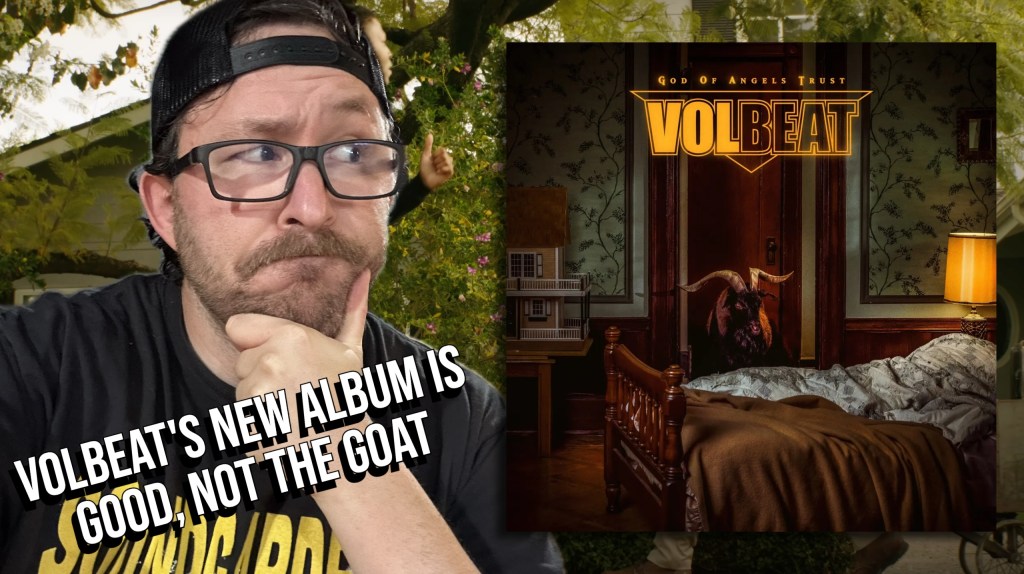
You’d think that because Volbeat named their new record an acronym of G.O.A.T., or Greatest of All Time, they’d have made more of an effort to truly make it one of their greatest of all time. And while God of Angels Trust is pretty good, it’s definitely not the G.O.A.T. within Volbeat‘s discography.
God of Angels Trust arrives four years after Servant of the Mind and marks a few firsts for Volbeat in the modern era. It’s their first without longtime lead guitarist Rob Caggiano since their 2010 record Beyond Hell/Above Heaven, and the first since frontman Michael Poulsen took a death metal detour with his new side project, Asinhell. In place of Caggiano, you’ll find guitarist Flemming C. Lund of The Arcane Order and of Volbeat‘s live band since 2023, handling all the leads on the record.
On writing the music for God of Angels Trust, Poulsen said in the press material around the record that he tried to be as spontaneous as possible, without much regard to traditional song structure: “In the past, I have taken a long time to write and obsessed over so many elements of the songs before finishing them. This time, I wanted to make a Volbeat record without thinking too much about it. Instead of following any kind of structure, I said, ‘okay, there are no rules. I could do anything I want. I could start with a chorus, or do songs that are just a bunch of verses stacked on top of each other. Anything goes.’ That was freeing for me, and it made it exciting to write this album.”
And yeah, 20 years in it’s great to see Poulsen still pushing for evolution within Volbeat, and for the most part that approach does pay off on this record. God of Angels Trust has some pretty exciting moments, but it doesn’t quite stick the landing and that’s sort of the problem.
Volbeat kicks things off with “Devils Are Awake”, whose runtime glaringly reveals that Poulsen is fresh off writing some death metal. After a punchy intro, “Devils Are Awake” moves into a faster verse and then drops into probably one of the best choruses Volbeat has ever written. Volbeat ties everything together at the end of “Devils Are Awake” with some slowed-down, Death-styled riffing, a change in the feel, and some huge harmonies to send the track off.
“By a Monster’s Hand” is a fairly straightforward, metal-tinged rock track that all of a sudden shifts gears right around the two-minute mark to a new tempo, some pretty fiery soloing, and some really chuggy riffing. Volbeat comes back to the main hook right at the end, and then the song is over. Two for two on really decent bangers thus far on this record.
The real takeaway here, with just these two tracks — “By a Monster’s Hand” and “Devils Are Awake” — is that Volbeat is getting really adventurous with their songwriting. Each track makes bold detours while still loosely following familiar structures. It’s a testament to the band’s craft, not just because the songs are strong, but because Volbeat pushes boundaries without crossing into self-indulgence or being boring. It’s gutsy without ever shouting, “Look at me. I’m complicated. This is a complicated song. Look how smart we are.”
“Acid Rain” changes up the mood of the record with its uplifting, major-key vibes and yet another hook-lined chorus. If there’s a song on God of Angels Trust that you’ll be humming to yourself for a few days after listening to the record, it’s definitely “Acid Rain”. There’s nothing particularly off-kilter about “Acid Rain” either, you know – it’s just verses and choruses, a big, slow bridge, and then a final chorus that totally gets the job done. It’s old reliable. It works. It’s catchy and I really liked it.
“Demonic Depression” is an interesting track in that it doesn’t ever broadcast really where it’s going next. There are a lot of twists and turns on this one that make the static, stable quality of the chorus that much sweeter when it hits. There’s a lot more finger-bleeding solos, more crunchy riffs, and it was right around this time on the record that I started thinking to myself, “I think I might love this.”
And then there’s everyone’s favorite track, “In the Barn of the Goat Giving Birth to Satan Spawn in a Dying World of Doom”, which I’m still not convinced wasn’t named by Karl Sanders of Nile in some drunken conversation with Volbeat. This one starts off like Glenn Danzig fronting a Johnny Cash cover band, and then eventually melts into this big, swinging classic heavy metal track. And yes, Poulsen works in the entire phrase “In the Barn of the Goat Giving Birth to Satan Spawn in a Dying World of Doom” right at the end before all hell breaks loose and a screaming solo just completely ends the song. Pretty impressive.
I have no problem saying that the first half of God of Angels Trust is all killer, no filler. The second half is where things get shaky.
“Time Will Heal” starts up with this pretty boxy guitar melody that sounds like something Cave In would do before leisurely strolling into the verses and choruses. There’s something about the melodic choices and how everything attempts to mesh together on this song that just feels kind of empty to me; like the separate components are there without being held together with any adhesive. “Time Will Heal” just feels a little lethargic and kind of unsure of itself.
“Better Be Fueled Than Tamed”, I think might be the most off-the-wall song on God of Angels Trust. This sounds like Jello Biafra fronting a country metal band at times, at least right up until the galloping breakdown toward the middle. “Better Be Fueled Than Tamed” doesn’t do much to separate itself from the heavier and more complicated songs on the first half of God of Angels Trust. But it doesn’t really need to either, because this, to me, is the sound of this record, and it works really well. So why deviate from it?
Then finally, there are the last three tracks on God of Angels Trust, and I think this is really where this record does not stick the landing.
“At the End of Sirens” is the longest track on the album and does next to nothing to warrant its runtime. The hook isn’t really good enough to bear repeating as many times as it does, and the song just goes on and on and on with very little to say.
“Lonely Fields” feels like everything you’ve heard up to this point on the record and just did a whole lot of nothing for me. “Lonely Fields” also breaks into this weird cover of John Carpenter‘s theme song from Halloween, but it’s in 12/8 instead of the original song’s 5/4. The lyrics of the song don’t really allude to being an homage to Halloween or about anything horror-related, so this cover of the Halloween theme song is just kind of in there. So basically, you have a fairly boring song with an unrelated semi-cover thrown in the middle. Pass.
God of Angels Trust closes with “Enlighten the Disorder”, which is a track that feels underdeveloped despite some pretty solid riffs strewn about. By this point in the album, the song’s familiar stylistic choices don’t make much of an impact, but whatever — it’s still the strongest of the final three songs, which I think might say more about its competition than the actual track itself. But yeah, I mean, as far as a closer goes, it’s fine.
At the end of the day, God of Angels Trust has a lot working in its favor. For starters, the production is crisp and punchy, with enough space for every instrument to really breathe and show itself. The mix hits hard without being overwhelming, and nothing really feels overly polished or sterile. It’s clear that Volbeat still knows how to make a record that sounds massive.
Poulsen also sounds remarkably strong throughout God of Angels Trust, which is great considering he underwent throat surgery in 2024. His voice has always been such a distinct part of Volbeat‘s sound — you know, it’s like that part Elvis croon, part Danzig Elvis, part “Yeah”-era James Hetfield, and part classic rock and roll snarl. And he continues to bring a ton of presence and grit here on this record as well. You can tell he’s excited about the songs, and that’s really refreshing to hear.
But this isn’t just the Michael Poulsen show. Lund steps up admirably in his first studio outing with Volbeat and brings a sharp edge and a technical flair to the lead guitar work without trying to mimic Rob Caggiano‘s style. It’s a different flavor, but it’s one that fits. Which again, isn’t that surprising, because Poulsen and Lund have a pretty long history together. They’ve been friends for a pretty long time. But still, Lund nailed it.
And then there’s the rhythm section, which is Jon Larsen on drums and Kasper Larsen on bass, who do exactly what a good rhythm section should be doing: lock in tight, provide the foundation, and occasionally sneak in these moments of little surprises. Whether it’s a subtle groove shift or a sudden rhythmic accent, they keep things feeling alive and dynamic and fresh and energized throughout the whole album.
More than anything, God of Angels Trust feels like a band that’s still hungry, still willing to take risks, and to challenge themselves. For a group two decades into their career, that’s no small thing. This is the heavy Volbeat record that I think a lot of longtime fans were really hoping for—and now they have it.
All that being said, I’m landing at a pretty solid 7 out of 10 on this one. One point for every track that I genuinely felt deserved to be on this record. And honestly, that’s not a bad score. It’s a strong record with plenty of moments that flirt with greatness, but with only ten songs, Volbeat didn’t really leave themselves much room for missteps. And unfortunately, those final three songs really just don’t hold up their end of the bargain.
Those three songs aren’t bad. Nothing on this record is offensively bad or totally skippable. But those last three tracks really pour water on a record that is otherwise on fire. Still, God of Angels Trust is, I would say, a win for Volbeat. It’s heavy, it’s ambitious in spots, and it shows a band that is still evolving while staying true to themselves. Even if it doesn’t quite live up to the G.O.A.T. acronym, it’s still a solid addition to the Volbeat catalog. And I would suggest that any fan of the band—either tangentially or, you know, pretty hardcore about the band — give it a listen. It’s still pretty good.
 (The) Greg Kennelty