Subscribe to my YouTube channel right here!
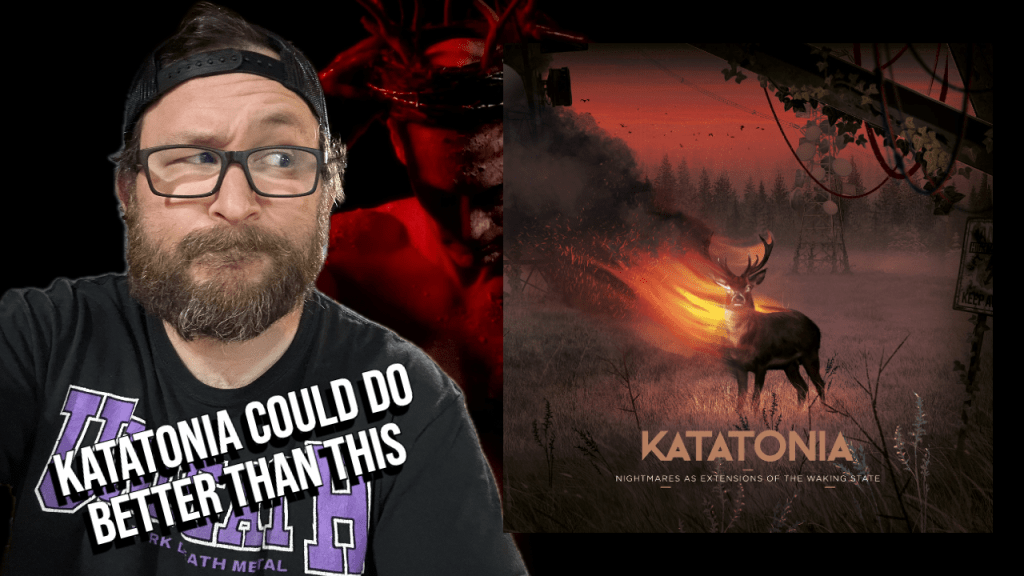
Swedish purveyors of gloom Katatonia are back with a new record called Nightmares as Extensions of the Waking State, and the band looks a little different these days. Notably absent from Nightmares is founding Katatonia guitarist and songwriter Anders Nyström, whose vacancy has been filled by two guitarists – Nico Elgstrand and Sebastian Svalland. This makes Nightmares the first ever Katatonia record without Nyström, so let’s talk about what happened there in terms of the split, and maybe how that’s not as much of a seismic shift as it might initially seem when it comes to songwriting.
Katatonia split with Nyström in March of 2025, with Katatonia vocalist and main songwriter these days Jonas Renkse saying in part at the time that it was “a decision not taken lightly, but for everyone to thrive and move forward with their own creative preferences as well as personal schedules. This has become the realistic option. Anders and I started the band in 1991 and his impact on the band’s trademark sound is undeniable. As bleak as this sounds and is, it’s further evidence of life getting in the way of our preferred plans. I wish Anders all the best for the future.”
However, when Nyström responded to Renkse with his own statement, there was definitely a little more acid in his words. In part, Nyström said that “Katatonia could and should have been mutually laid to rest while exploiting the freedom to continue in any desirable direction under a new name. But with Jonas now regrouping with new members and navigating further in his own direction, I no longer need to wait and see which way the wind is blowing to enter that void and grab hold of what’s been abandoned.”
And while it certainly sucks that a musical partnership that’s given us so much great music has ended after you know, being formed in 1991, a quick look at the writing credits on the past few Katatonia albums shows you why this isn’t maybe a huge shift when it comes to writing. Renkse wrote all the music and lyrics on Katatonia‘s 2023 record Sky Void of Stars and 2020 record City Burials. The last time Nyström was credited as a co-writer on Katatonia songs was on the 2016 record The Fall of Hearts, and Nyström wasn’t even a lead writer on any of those songs. Renkse was.
So I’m not saying that Katatonia without Nyström isn’t a huge bummer because it definitely is – and again, to see a musical partnership that’s given us so much great music over 30-plus years finally ending is certainly a bummer – but we’ve also gone about a decade since he contributed to any Katatonia music in the studio. So compositionally, the trajectory still is what it’s been for the past two records.
But regardless of the split, regardless of who’s in the band and who wrote what, Nightmares is at its heart a pretty good example of an album that could have been a very solid EP.
The first half of Nightmares feels like Renkse writing from the perspective of everything from The Great Cold Distance to The Fall of Hearts, though without being a blatant callback to any specific moment on those records. The opening song “Thrice” makes an immediate statement as it alternates between these forcefully heavy parts made all the groovier by Katatonia‘s penchant for layering rhythms and weaving through time signatures; to these quieter, more atmospheric sections that build up loads of tension toward the end of the song.
Then there’s “The Liquid Eye,” which smooths over the wild musical fluctuations of “Thrice” by keeping the shifts to the heavier material a little less jarring. It almost feels like some of the more darker and somber tracks on Night Is the New Day. And once that’s all wrapped up, then you’re thrown to the devil himself on the song “Winds of No Change.”
“Winds of No Change” is nothing like Katatonia has ever done before in some aspects. Upon hitting play, you’re greeted with this slithering, distorted bass line, some huge roomy drums, and a full-on choir that sticks around for the duration of the track. If you ever wanted to hear Renkse sing the phrase “Hail Satan” alongside a choir and some pretty dreary atmospheres, this is definitely it. “Winds of No Change” is what I’d imagine a band would play in hell to a stadium of the damned before Satan took the stage to do whatever it is that Satan would be doing on stage in hell.
Then you’ve got the song “Lilac,” and I was originally a little critical of this one when it was released as a single, in that it didn’t do a great deal to differentiate itself from anything Katatonia has done over the past 15 years. But in the context of the record, it definitely makes more sense. Renkse seems to have written the first half of this record with a very push-pull mentality. Songs like “Thrice” and “Winds of No Change” are definitely more adventurous and progressive in their flow, while “The Liquid Eye,” “Lilac,” and Side A’s final track “Temporal” pull listeners back in with a more familiar Katatonia sound.
The first four tracks on Nightmares are totally solid and would absolutely be a part of my hypothetical EP. “Temporal” is where the cracks in the foundation start to appear. It’s not a bad song, but it doesn’t do much to drive the record forward or expand its sonic palette. It’s just kind of a boilerplate Katatonia song in modern times.
Side B kicks off with the notably calmer “Departure Trails,” which is a decent song, but it just falls short in terms of personality against everything that you’ve heard up to this point on the record. “Departure Trails” feels more like something that was demoed and ready to go for Dead End Kings, but didn’t really make the record for whatever reason.
And it’s tough to make a case for “Departure Trails,” because the next track “Warden” feels like a better version of it. “Warden” distills that moody, quiet Katatonia sound down to its key elements and plays more with dynamics to keep things lively. Especially around the 1:52 mark, where all of a sudden the song just drops off and a pretty energetic, catchy chorus kicks in. It feels like Side B could have kicked off with “Warden” and the flow of Nightmares would have been that much better.
Following that is “The Light Which I Bleed,” which makes great use of rhythmic trickery and a chord progression that almost offers some positivity — except it’s Katatonia, so the major chords that it ends on promptly get knocked down to minor chords. “The Light Which I Bleed” is on track to be a pretty decent song except it hits this full, room-filling orchestra riff in unison with the band and then fades out into nothing.
And I’m not opposed to fadeouts — my love of ’80s pop music can certainly attest to that — but the fade-out in “The Light Which I Bleed” feels more like an admission of not knowing how to end the song than it does a purposeful ride off into the sunset. It’s like we got half a song and then a good transition into the second half, but then nothing else.
Then Katatonia hits you with “Efter Solen,” which is easily one of the best songs on Nightmares. “Efter Solen” – or “After the Sun” in English – is a piano-driven track sung entirely in Swedish, and is backed largely by heavy doses of electronic percussion and miscellaneous synthesizers. Renkse really shines on “Efter Solen,” both musically and vocally, as he knows exactly where to drop the hook, where to build tension, and how to arc the writing on this to be simply as beautiful as it possibly can throughout — but still pretty engaging, and more importantly, without feeling cheesy with a lot of these major chords. This is a really good song.
“Efter Solen” also reveals a new dynamic for Katatonia that I’m really hoping we get more of in the future. As in, if Katatonia went back and either wrote new songs or reimagined old ones in this style, I think it would be really cool. It’d be like Dethroned and Uncrowned, made far stranger by some Aphex Twin-inspired electronics. I think that would be awesome.
And then there’s the closer “In the Event Of,” which brings the album to a heavier finish alongside some pretty liberal uses of Mellotron throughout. I’m not gonna sit here and say that it’s the best album closer Katatonia has ever done, but it’s a contrast to “Efter Solen” and a callback to the heavier first half of Nightmares. It’s smart to end this album on a song like “In the Event Of,” I just wish it was more interesting.
Nightmares is an alright album, but it feels very lost. At least with records like City Burials and Sky Void of Stars, there seemed to be a pretty easily-located thematic throughline with the writing. Nightmares has that in the first half for the most part, but it totally gets lost in the second half.
Nightmares would have been a solid EP if it was “Thrice,” “The Liquid Eye,” “Winds of No Change,” “Lilac,” “Warden,” and “Efter Solen” – and even those songs could use a little tightening up here and there. But, you know, as it is, if we just kind of got an EP of those songs, it would have been pretty good.
It’s worth mentioning at this point that Nightmares is the first Katatonia record to be released two years after its predecessor. The last time that happened was between Tonight’s Decision in 1999 and Last Fair Deal Gone Down in 2001. So maybe a longer incubation period would have allowed Nightmares to fully flourish, because again – there are good ideas and some pretty cool writing things going on on this record. But as a full body of work, it just kind of falls flat.
Renkse actually addressed the short wait time between records in an interview with Blabbermouth, saying: “I remember immediately after the Sky Void of Stars touring was done, I thought that I would take a break from writing because there was no rush to do anything. I was still writing a lot of stuff. Eventually, the label asked our management, do you think they can make another album? I had the question. I was browsing through my ideas, and I thought maybe there’s enough material to actually work on an album here. And there was. The guys in the band really wanted to do it. I felt there was probably a good set of 10–11 songs here. So let’s do it.”
The other, obviously but still notable thing about Nightmares is the lack of Nyström guitar solos. I don’t think I realized just how much of a musical storyteller Nyström was on his instrument until he was gone from the band. Not to say that Elgstrand and Svalland didn’t do a good job because they certainly did, but Nyström’s absence is certainly felt — and how could it not be? Whether he was writing tracks or simply playing on them, Nyström was a part of every Katatonia release up until now. Someone with that longevity and that much of a musical voice in a band is certainly going to be missed.
All that being said, Nightmares as Extensions of the Waking State is a 6 out of 10 for me. There are things that I do like about this album, but a very inconsistent second half and a kind of boring lead-in to a very inconsistent second half definitely weakens it. I think Renkse and his new guitarists maybe need a little more time to find their groove, because Sky Void of Stars and City Burials — again, written entirely by Renkse — were pretty good. So the man can obviously write a song, but this is just not all that good. Here’s hoping the next record is better.
 (The) Greg Kennelty