Subscribe to my YouTube channel right here!
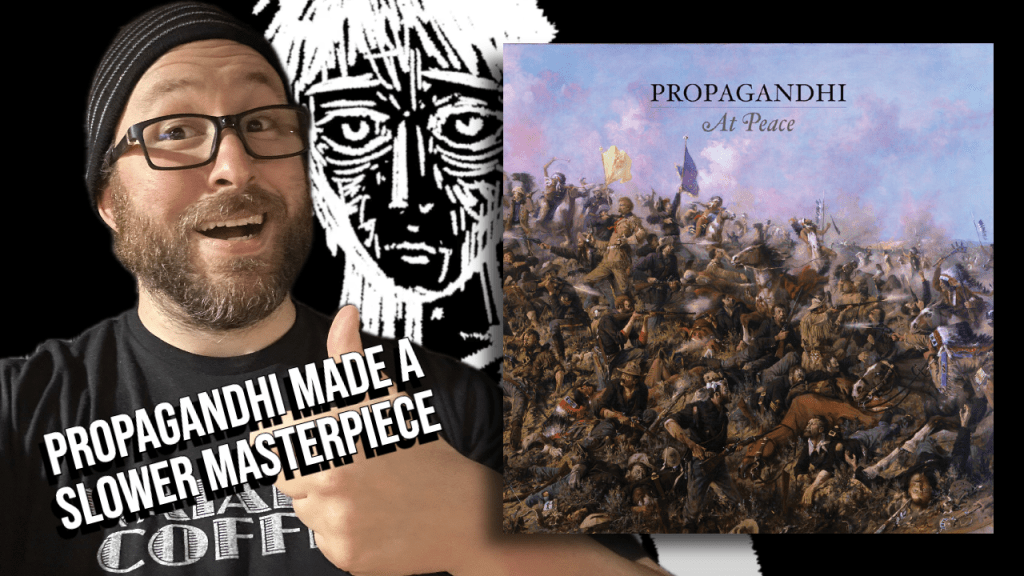
Legendary Canadian punk band Propagandhi is back with their first new record in eight years, titled At Peace, and there’s been a pretty significant tonal shift in the band’s delivery and in their writing.
Propagandhi‘s last record Victory Lap in 2017 – and the records that preceded it – felt fiery, as if the band wanted to scream loud enough that more ears would perk up to what they were saying. At Peace feels more like a resigned existential crisis that’ll gladly regale you with its experiences and its stories, but with more of a kinda do whatever you want with this information attitude.
On the record itself, Propagandhi frontman Chris Hannah said At Peace finds him personally at the crossroads of either continuing life as German-born spiritual teacher and self-help author Eckhart Tolle, or going a slightly more drastic route. Hannah said: “Speaking for myself, this record might be a snapshot of me deciding whether I’m going to live out the rest of my life as Eckhart Tolle or live out the rest of my life as Ted Kaczynski.
“Everything I’m singing about is still coming from being the same person that wrote and sang our first record How To Clean Everything in 1993, but what we’re putting into the songs now probably reflects more despair than 30 years ago, when we had similar perspectives, but with strands of hope and naivety. Now it’s the existential dread of eking out a life worth living in this completely failed society.”
Hannah elaborated on that quote a little bit in an interview with Metal Hammer, saying: “I think everyone’s familiar with the adage, accept what you cannot change, and change what you cannot accept. There is a sort of Eckhart Tolle movement to accept what you cannot change. On the other hand, how do you change what you can accept in a world where it’s been proven time and time again that nothing will change and in fact, it will only get worse? That’s where the Ted Kaczynski reference comes from. Someone hopeless in despair, and they cannot be a part of this. They leave society and attack it from the outside.”
Musically, Hannah said in a different interview with New Noise Magazine that the record was intentionally very collaborative. “With this record specifically I feel like we made a conscious effort where we actually spoke it out loud to each other in the practice space. We wanted to make a very open, very transparent kind of naked record.” And in that same interview, Hannah acknowledges that At Peace is slower, and that it’s something he wishes Propagandhi had done more of in the past. To quote Hannah: “listening to the last few records, we’re like, that’s too bad we didn’t play that song a few beats slower.”
So now that we kind of have a little bit of context set up here, let’s take a look at each individual song on At Peace.
It’s evident from the opener “Guiding Lights”, that Propagandhi is up to something new. “Guiding Lights” is a slow chugger of a song that features some glitchy, impressive guitar playing and some very tribal-sounding vocals that are pretty much constantly all on the strong beats. The song also immediately highlights the talents of drummer Jord Samolesky, whose use of snare drum ghost notes and sparse fills drive this track in a way that I’m not sure anybody else could. “Guiding Lights” is restrained but disgusted, and I think that really sets the stage for At Peace. This isn’t a rager of an album, and certainly not one to incite any circle pits anytime soon. It’s contemplative and dark, waiting for, hopefully, the sunrise of a better day.
Then there’s the title track “At Peace”, which feels like a cross between the darkness of Failed States with the catchiness of Supporting Caste and Victory Lap. The song rips through thrash-leaning riffs, vocals that alternate between the spoken and the sung, and even a little humor in lyrics like: “oh yes, I’m really fun at parties. Draw a dink on my face with a Sharpie. Excuse me, sir. This is an Arby’s.”
And it’s worth mentioning that, yeah, half the reason I listen to Propagandhi is their incredible lyrics. I absolutely love how they swing between the overarchingly political and the deeply introspective, while managing to tie it all together beautifully. I mean, come on, even the closing stanza brings it all together so damn well. Those lyrics are: “Some days I’m scared I’m gonna die, or, even worse, I might survive. I try to keep these words in mind, ‘nothing worth having comes without some kind of fight. Gotta kick at the darkness till it bleeds daylight.’”
If you’re unfamiliar, that very last line about kicking the darkness till it bleeds daylight is a reference to Bruce Cockburn‘s 1984 track “Lovers in a Dangerous Time”. As for the track “At Peace”, this is pretty much the closest you’re gonna get to a mid-career Propagandhi punk banger.
“Cat Guy” slows things back down and lyrically might be one of my favorite tracks on At Peace. “Cat Guy” presents this ethical dilemma of someone watching baby Hitler and your family dog drowning in a lake before slowly spiraling into an existential crisis on time, man, and the nature of man. But then right at the end comes back to the original question with the answer: “So tell me, which pitiful creature would you condemn? Which of God’s children would you save? As for me, I never learned to swim. Always been a cat guy anyway.”
“Cat Guy” speaks volumes to Propagandhi‘s ability to think incredibly deep, but also not take themselves too seriously and kind of know when to inject humor. This and “Prismatic Spray (The Tinder Date)” do a great job with that, made all the better by frontman Chris Hannah‘s deadpan delivery of the lyrics.
“No Longer Young” picks up the pace again and seems to be a meditation on the impermanence of life and remembrance, which then launches into “Rented P.A.”, which seems to kind of lyrically intertwine with “No Longer Young”. Both are fairly upbeat, punkier tracks, though the lyrics feel like they’re told by two different people — “No Longer Young” by someone who’s acknowledged they’re lost and is trying to find their way, and “Rented P.A.” by someone who doesn’t want a big deal made of their death. But they don’t feel somber, as pretty much none of At Peace does. Both songs feel stoic in their stare down of death.
There’s also a little levity in “Rented P.A.” with the line: “When you finally lower me into that grave, Take Off to the Great White North sputtering out of a rented P.A. Spare a prayer for wayward souls.” For those of you who have no idea what that means, “Take Off” was a 1981 track by fictional television characters Bob and Doug McKenzie, played by Rick Moranis and Dave Thomas and featuring guest vocalist Geddy Lee of Rush. So just about as Canadian as you can get.
Then you’ve got “Stargazing”, which is definitely the most experimental track on At Peace. The song employs what I’m guessing is a glockenspiel and piano alongside some lightly affected guitars before leaning into a song that’s largely dependent on bass, drums, and synthesizers. It’s an extremely hard left turn for Propagandhi in terms of instrumentation and in terms of their writing, but it’s one that I hope they can blend into their sound more as time goes on, because it’s pretty cool. “Stargazing”, as it is, is again pretty interesting, but I do wish there was maybe one more section that would kind of shift the energy a little bit and tie it all together. “Stargazing” is also further proof that bassist Todd Kowalski is one of the best bassists in punk and should be lauded far more than he is.
Then you’ve got “God of Avarice”, which is a solid mid-tempo rocker that, much like the opener “Guiding Lights”, features some cascading high-string guitar riffing. I have no idea if that’s Hannah or lead guitarist Sulynn Hago, but it’s a very cool style that feels reminiscent of parts of Tool’s “Tempest”. “God of Avarice” also has a really great flow going from a pretty punchy opening to a way more subdued middle section, only to bring that intro energy back at just the right time.
Then we get to what might be my favorite track on At Peace, outside “Cat Guy”, “Prismatic Spray (The Tinder Date)”. It’s a big swung track that’s got plenty of great riffs, but the lyrics are just so damn good. The song pits this really serious, intellectual type character against a Tinder date, who, I guess, seems to be pretty into it. And I think the humor of that song can pretty easily be summed up with the second line that reads: “I said, the intellectual depth that leads to wisdom and happiness has been discarded in favor of shallow forms of reflection and recall. She bit her lip and she took my hand as we crossed from Frontier to Adventureland.” Perfect.
And then the rest of the song follows this kind of date as this couple walks through Disneyland before, presumably, a nuclear bomb goes off and completely obliterates them while they’re having sex. Truly an end that we can all aspire to.
Following that you’ve got “Benito’s Earlier Work”, which alternates between these long, drawn-out tones and adventuring into some more straightforward thrash-type riffs. While “Vampires Are Real” offers up the closest thing you’re gonna get to an old-school Propagandhi punk track. It’s even got a snarky audio sample right up front, making fun of the band’s critics. So you know they mean business.
After that, there’s “Fire Season”, which is definitely my least favorite song on At Peace. It just does a lot of what these slower-then-faster-then-slower songs do on this record. It’s also really the only song on At Peace that I constantly forget what it is until I get to it. It’s not a bad song, and it definitely doesn’t derail the record or anything. It’s just—it would be my best candidate for a song that would be cut if any songs needed to be cut from this record.
Which is kind of crazy, because after that, there’s “Day By Day”, which is another contender for one of the best songs on At Peace, as it marries pretty much everything you’ve heard on the album up to this point into nearly four minutes of total perfection. “Day By Day” has everything from that classic, driving Propagandhi punk fire to some extremely tasteful, quiet sections rife with, yet again, the band’s impressive and super precise rhythm section.
I said it before, and I’m just gonna say it again—the world really needs to come around to Samolesky and Kowalski being one of the best rhythm sections out there, in that they are just so damn musical and far-reaching beyond the punk genre. They’re just really, truly incredible musicians. And again, more rhythm sections need to be like these two. They’re just so good.
Then we arrive at the closer “Something Needs To Die But Maybe It’s Not You”, which I’ll be honest, I did not like this song the first time I heard it. I thought it was kind of too slow and too static to be a closer for the record. But the more I heard it, the more I thought this is actually beautiful. “Something Needs To Die” is mostly a solemn musical march to the end, but the lyrics might be some of Propagandhi’s best and most personal to date.
The song focuses on a character that’s talking to the listener, essentially reassuring them that while everything certainly sucks and the world seeks to only distract for its own benefit, they’ve got something unique and important to the world. You have something unique and important to offer to the world.
To quote the entire first stanza, because I just can’t stop thinking about it: “Staring at the ceiling in the darkness. Your mind is racing, repeating: life is but a manic series of deflating failures when compared to the images that flash across the screen. What’s the point of all this? What does any of it mean? Good question! I’d like the answer myself, but there’s one thing that I know about you for sure: you were sent here with a Gift. But the realm in which we exist seeks to dazzle, to confuse, with every cheap, tawdry ruse; ’til we forget what it is.”
The song also doesn’t go out on some fading instrumental bit or big bombastic moment. Instead, the entire band hits on the beats together as Hannah poses one final question to the listener: “You may feel ill-equipped and aimlessly adrift, but you were sent here with a gift. What will you do with it?”
Given At Peace’s general exhaustion with the world, “Something Needs To Die” truly is the perfect ending in that it feels like the band is passing things off to the listener. The record’s over now, and it’s your time to do whatever it is that you have to do.
The first few listens through At Peace, I was actually kind of bummed. It wasn’t really what I was expecting, and it wasn’t really in the vein of anything that Propagandhi had done before. But the more I listened and that shock kind of wore off, I realized that At Peace is genius. The songwriting on At Peace feels very stream-of-consciousness at times and other times very composed. It has this flow of uncertainty to it, yet, at the heart of that, knows exactly what it wants to say in any given song. You just need to have a little patience to hear it out in its entirety, which, you know, is kind of a lost virtue these days.
But listen to it. Really, really dive in and listen to this record, front to back, no distractions. Look at the lyrics and just dive in. The musicianship on At Peace is incredible, as usual, and the mix is great too. No element really goes unheard on At Peace. Everything that’s going on in any given song, no matter if it’s just the band doing what they do, or a bunch of extraneous instruments—you can hear everything.
Listen. At the end of the day, it’s been eight years between Propagandhi records. They’re different people now, and so are the rest of us, either in small ways or in completely radical ways. The more I think about it, the more I’m happy that Propagandhi didn’t come back with like a Victory Lap Part Two, or, you know, Supporting Caste Part Two, because we’ve already got those records. And hearing a band rehash old sounds that their hearts are no longer in, or that don’t really embody them as musicians at the time, is very boring and disingenuous.
This is Propagandhi in 2025. And I am definitely here for it.
At Peace is slower, more experimental, and largely doesn’t touch much on the band’s punk roots. It almost feels like a slow thrash record at times, which I guess isn’t too surprising, given the band’s love of heavier music that they’ve put on prominent display over the years. At Peace is not what preceded it, but it’s the opening of a new chapter for the band that starts off very, very strong.
At Peace is a nine out of ten for me. This record grew on me big time, and I really do think it stands up to everything else that Propagandhi has ever done. It’s just different. But when has Propagandhi ever stayed static? No two Propagandhi records are ever the same, and I think more people would have rated At Peace higher if there was a record between it and Victory Lap that kinda eased that transition.
But we didn’t get that. Propagandhi took eight years and they came out with something completely different. And I urge every Propagandhi fan and anyone who’s even curious about the band to listen to this a few times. Really immerse yourself in the lyrics. Really immerse yourself in the music. Really just listen to this thing as a whole, because you’re probably not gonna fall in love with it the first listen through, but you are almost definitely going to fall in love with it maybe the fifth or sixth listen through.
 (The) Greg Kennelty